Saturday, March 9, 2013

My Big Fat Burkinabe Funeral


Thankfully, I have not personally experienced a large number of funerals in my lifetime.   However, I will probably never experience a funeral that’s even remotely similar to the one that occurred in my village a couple weeks ago.  I was completely unprepared for the event, which was some combination of a family reunion, a feast, a concert, a holiday, and a college frat party.  Almost forgot, it was also a cultural celebration of sorts.  It lasted over 48 hours. And my humble abode was smack in the middle of all of the festivities.

My house is conveniently located in the middle of a group of family compounds that house the chief/councilor of Takaledougou and his numerous family members.  I use the word “convenient” because it has been relatively easy to establish a personal relationship with the chief and other important individuals in the village who meet with the chief on a regular basis.

Since moving to the village, I became aware that an older woman in the chief’s family was gravely ill.  It’s hard to determine the exact relationship of the chief to the old woman, who he referred to as his mother.  However, she is the only surviving wife of the four wives of the former chief, which complicates the term “mother.”  The family tree is probably more of a family bush.  Lots of girth.

A quick tangent: Imagine having four wives! Sounds awesome, right?  Christian Burkinabe are technically not allowed to have more than one wife, but polygamy is relatively common among the Muslim population.  Polygamy is generally a village phenomenon, but there are a select few husbands who “cheat” the system by living and working in one of the bigger cities of Burkina while maintaining wives and children in the village.   After pondering the subject for some time, I grew increasingly frightened at the prospect.  Some families with multiple mothers seem to function well, especially if the husband is respected and well off financially (i.e. chief of the village).  On the other hand, wives often develop rivalries for the affection (or money) of their husband, with the well-being of their children as a paramount concern.  The kids can also develop rivalries if their moms don’t get along.  All in all, it sounds like the makings of a horrific soap opera which I have no intention of ever taking part in.  Unless I meet the right women.

Anyhow, one fine evening I was relaxing in my house reading the B volume of Encyclopedia Britannica when suddenly I heard a group of women wailing and running around outside.  I put down the heavy, leather-bound academic reference tool and peeked out my windows. I witnessed the chief with a group of eight men talking in hushed voices and a group of women wailing incoherently at the top of their lungs.  They were clearly very upset about something, as I had never seen women in my village express that much emotion.  I began to suspect that the older woman in the chief’s family had died.

My suspicions were confirmed when I saw a body shaped object being wrapped in a white sheet, rolled up tightly in a bamboo mat, and placed on the tomb of the former chief, conveniently located in the middle of the family courtyard.  The group of women who had been wailing began dancing in a circle around the tomb and chanting in local language.  Within the hour, a traditional Burkinabe music group had materialized and began banging away on drums and bylaphone (a marimba made from gourds, bamboo, and wood).  Little did I know, I was not going to get much sleep that night. 

As it seemed like just the family was involved in the night’s activities, I decided to sit out.  I called my friend in village, Ibrahim, and he explained that it was indeed the beginning of a funeral, but that the official events would take place the next afternoon and night.  He also explained that the music and dancing was meant to drive bad spirits away from the body during the night.

They were serious about keeping the bad spirits away, as the music and chanting continued all night: 6pm to 6am the next morning.  I got a couple hours of sleep and then gave up.  The next day, the attendees of the funeral began arriving in a variety of vehicles ranging from Yamaha motorcycles to Mercedes Benz sedans.  As I walked to the health clinic, I witnessed a group of ten men with shovels digging a large hole in the field next to the chief’s compound.  I probably should have guessed that they don’t have graveyards in Burkinabe villages, but it was still pretty shocking when I realized what the hole was for.  By the time the afternoon rolled around, there were over 200 people gathered in and around the chief’s courtyard.

At around 4pm, the official ceremony started. Before the chief’s wife was buried, she was given a special send off into the afterlife.  Two older women in the village who had personally known the woman lifted her body, still wrapped in the bamboo mat, onto their heads and started parading around the crowd.  A group of ten women followed the body, dancing and singing and chanting.  The traditional Burkinabe music group was backing them up with a combination of upbeat melodies.  The chief and other respected family members took turns leading the body through the crowd, which immediately parted to make way for the deceased.

Throughout the entire spectacle, people were dancing, singing, cheering, and recording the festivities on their camera phones. At one point, the women carrying the deceased began a playful game that I call  “body tag.”  They would run the deceased through the crowd, attempting to get others to come into contact with the body.  This was apparently a faux pas, because anyone who touched the body was hit repeatedly by the women following the body.  Cries of laughter rang out from the crowd every time someone was tagged.

After about an hour, the time came to bury the body.  The immediate family of the deceased carried her to the grave and lowered her down.  The mood immediately became somber as the family said their last farewells.  Men who were already dirty from digging began filling the hole.  A palm branch was laid over the grave and the chief gave two older men a rooster from his flock.  Although I had gotten to know many of the chief’s animals, I didn’t know this rooster personally, which in retrospect was for the best.  One of the older men unsheathed a ceremonial dagger and slit the rooster’s throat, spraying the blood over the grave.  As most of the men had their heads bowed in silence, I felt it was an inopportune time to ask why the animal had been sacrificed.

With the official ceremonies over, there was a pause in the festivities as women began preparing a massive feast and proper amounts of dolo (millet beer), banji (palm wine), hard alcohol, soda, and other beverages were acquired.  I returned to my home, unsure of what was in store for the night.  With hundreds of people partying around my house, I decided to enjoy the sights of the funeral from my windows for a couple hours.  After night fell, I ventured out to find Ibrahim drinking with the chief and some of the wealthier village men. I was offered a drink consisting of ginger mix and Pastis, a 90 proof French hard liquor.  It’s the Sailor Jerry’s of Burkinabe hard alcohol.  Needless to say, I got drunk pretty fast.

With the traditional Burkinabe music group still going at it, many people had begun to dance.  After countless women begged me to dance (two…and they were told to by the men I was with), I decided to join in the festivities.  I danced, trying to copy the moves of other Burkinabe, which was pretty easy until someone decides to show off.  On account of getting little to no sleep the night  before, I grew tired  around midnight and decided to take a little nap, telling my friends I’d be back.  As anyone who’s tried to “just take a nap” after drinking heavily can tell you, you aren’t coming back to the party.  I woke up around 3am to people still partying and dancing and singing. The party continued until sunrise.

The funeral was an eye opening experience. It was entirely possible that I was exposed to more traditional Burkinabe culture in those 48 hours than in the previous four months.  It would be easy to conclude that the villagers who were taking part in these unique cultural practices are simple minded animists who believe that these rituals are necessary to ensure a smooth passage into the afterlife.  However, I found myself pondering the validity of such a conclusion.  Many of the chief’s relatives are highly educated, wealthy men and women.   They don’t exactly fit the stereotype of the “simple minded villager,” especially when they show up in Mercedes Benz’z (plural…?)  and use their smart phones to take videos of the celebration.

While funerals in America are often somber, religious events, funerals serve an entirely different purpose in Burkina society.  Grief was expressed by immediate family members, but the funeral was a celebration of the life of the deceased.  It was a rare chance for the entire family of the chief to gather together, catch up, and reacquaint themselves with the village they came from.  The rituals performed at the funeral have no doubt been practiced for hundreds of years, but it was clear that the meaning of the rituals had fundamentally changed.  While the rituals still hold religious importance for many in the village, most of the chief’s family considered the rituals a celebration of Toussian culture and ethnicity. 

Imagine a Burkinabe attending a large American funeral.  It’s likely that a number of customs and rituals of the funeral would seem very strange.  For example, most people wear black to American funerals as a symbol of mourning, in contrast to the purposeful display of bright colors in the dress of Burkinabe at funerals.  Eulogies would also seem strange to Burkinabe, who would question the necessity of talking about a person who everyone attending the funeral knew.  The sheer amount of grief expressed at an American funeral would also be alarming to Burkinabe, who tend to view life as a struggle that one is lucky to survive to a ripe old age.

Clearly, one set of cultural practices is not “right” or “better” than the other.  Both sets of traditions are important because they represent different approaches to the question of death in human society.  Just as the rituals of a Burkinabe funeral hold different meanings for different people, the rituals of an American funeral do not mean the same to everyone.

As I sit in here drafting my last will and testament, I am moved to request that a majority of the aspects of the funeral I had experienced in Takaledougou be included in my own.  I can picture it quite clearly:  the chorus of voices singing “Sweet Home Alabama” as they celebrate my journey into the afterlife, the laughs and shouts of onlookers as respected women in my life chase people around with my body and strike them if they accidentally to touch me, and of course, the all-night party that will commemorate a life lived to the fullest.

Gotta start saving up for that open bar…..

Disclaimer: Not all Burkinabe funerals are like the one described above.  When young men or women die before living a full life, funerals are a much more somber occasion.  Funerals are also considerably smaller when the person in question is not a member of the chief’s family.  As with most cultural aspects of Burkina Faso, the type of funeral I experienced is specific to the region in which I reside. 

Sunday, February 24, 2013

It's not all fun and games.....

But sometimes it is!  Like when we travel out  of site for trainings!  Here's a great post by a great friend of mine, Hallie, about our regional language training in Oradara a week ago.  I biked from my site to Bobo on Saturday to meet Hallie (70 km), then we biked from Bobo to Oradara on Sunday (76 km).

http://hallieburkinafaso.wordpress.com/2013/02/17/orodara/

Read her other posts too!  She's almost as funny as me.  Not quite.  She's a clown. And a dinosuar.


Rawr.

Tuesday, February 12, 2013

The Burkina Bro Code


It’s no secret that men and women are far from equal in many societies of the developing world.  This inequality is hardly surprising, especially considering the fact that women only recently gained protection from discrimination under US law and they continue to struggle for true economic and social equality.  In Burkina Faso, traditional gender roles exhibit a large amount of influence over the behaviors of Burkinabe men and women.

Rather than engage in a sociological examination of gender roles in Burkina Faso, we thought it would be more enlightening to reveal excerpts from two ancient Burkinabe codes that illustrate the obligations and expectations of women and men in Burkinabe society.  These codes have been passed down orally through the generations, typically from father to son and mother to daughter.  There is no tangible reward for obeying these rarely spoken Articles, but membership in the village community is contingent on compliance.  It should be mentioned that in the larger cosmopolitan cities of the country these social norms are gradually disappearing, but at the village level, they remain highly important and influential.

In our unique position as culturally integrated, but foreign, individuals, Peace Corps Volunteers are not strictly bound by the laws dictated in the codes.  This invariably leads us to overhear bits of the conversations that serve as the medium for the ritual passing down of the code.  Thus, we are able to view expectations and behaviors as they contrast with our own, American, concepts of gender equality.  Our work is largely inspired by Barney Stinson of How I Met Your Mother fame, the pioneer of Bro Code transcription.  As he eloquently states:

“Whether we know it or not, each of us lives a life governed by an internalized code of conduct.  Some call it morality. Others call it religion.  I call it the Bro Code.”   -Barney Stinson

Below is the product of hours of back-breaking observation, tedious translation, and conference calls often ending in heated argument.  It was a test of friendship in the truest sense. But from the heat of the forge came a bond stronger than steel.

Burkina Bro Code


Article 1: Bros shall never cook, clean, wash dishes, fetch water from the pump, do laundry, or accomplish any other daily chores that are better performed by children or women.

Article 17: A proper bro always wishes fellow bros “bon appetite” while they are eating, but refuses the subsequent invitations from said bros to eat their food (vous etes invite).  To accept such an invitation would reveal to other bros that one cannot feed himself

Article 23:  Bros shall never refuse a calabash of dolo (millet beer). After accepting said calabash, the proper bro will purchase another, expressing solidarity with his fellow bros.  However, a bro shall always consume his dolo in a timely fashion.  Other bros are waiting for your calabash.

Article 24: Bros shall offer their seat to any senior bros, by age or importance, in attendance.  If there are not enough chairs for all bros, the youngest bro must find another chair, find another object to sit on, or order the closest child to find a chair

Article 29: Bros shall ask every American woman to marry them on the off chance that they will consent

Article 35: Bros shall always hold hands with other bros when walking places at night

Article 42:  A bro shall never reveal to another bro’s first, second, or third wife the contents of a bro chat

Article 48: Bros shall refer to their wives in all languages as “my woman”

African Santa on a Coke bottle
Article 51: Bros shall always claim to only play “a little bit” of soccer when white bros ask, hiding the fact that a team of random Burkinabe men in village would beat most MLS teams

Article 55: A bro shall use his children and the children of others for small, medial tasks that would be inconvenient for the average bro.  This includes any task that requires standing up and leaving the shade.

Article 69: Bros shall commit to practicing sound family planning: fathering as many sons as possible

Article 77: A bro shall spend no less than 2 hours per afternoon chilling with fellow bros in the shade, making Chinese green tea, and discussing topics of interest to the average bro

Article 82: All bros shall master the art of tying suitcases, bikes, motos, vegetables, mattresses, furniture, animals, and any other common luggage items to the top of vehicles.  When in doubt, maximize horizontal space before building vertically, but as long as the vehicle doesn’t flip over, it’s probably fine.
Photo Credit: Natalie Moore


Article 88: Bros shall own at least one machete.   Occasionally, bros should carry around their machete if for no other reason than to remind fellow bros that they own one

Article 93: A bro who has possession of an mp3 capable cell phone shall grace others with terrible downloaded music

Article 99: Bros shall teach their offspring to ride a bicycle as soon as their feet can reach the pedals, whether or not they are tall enough to simultaneously sit on the seat and pedal.  Bicycles allow children to run errands faster.

Article 102:  A bro’s moto is a reflection of himself.  Therefore, a bro should wash his moto at least as often as he bathes, if not more.

Article 105: Bros shall avoid any and all public displays of affection toward their wife (or wives).  Seriously bro, get a room

Article 106: On special occasions, bros should bust out their "Sunday best,"  i.e. matching pant/shirt suit combos known as "comples"

White Bro, David, properly rocking the comple 
Article 107:  It is often the bro who speaks the loudest who is the most correct.

Article 110: Muslim bros shall follow the teachings of the Koran and refrain from drinking alcohol.  However, dolo doesn’t really count as “alcohol” because it doesn’t come in a bottle and a bro can never be sure how alcoholic it is.

Article 115: Bros shall punish any dogs that seek affection, bark, or exist.   Chances are, if the dog is still alive in Africa, it did something immoral to survive.

Article 118: Whether a Bro cares about soccer or not, he cares about soccer

Article 120: Bros shall cover their motos with ominous bumper stickers that declare “God is watching,” “Suffering is good advice,” or “No money, no friends.”

Article 127: A bro shall not allow another bro to get married until he is at least 16.  At that age, bros shall help their fellow bros find suitable wives and start a family.

Article 129: Bros shall celebrate a marriage or the return of fellow bros from a Mecca pilgrimage by driving motos at unreasonably fast speeds, honking their horn, and attempting dangerous tricks such as the infamous “Look no hands!”

Article 131: Bros don’t speak French to one another in village, instead using the appropriate local language.  This would be an embarrassing admission that French culture exhibits a large amount of influence over African nations.

Article 134: Bros may refer to bros from other ethnic groups as “my slaves” if, at any point in Burkina history, their ethnic group exercised political control over the other.  This is also referred to as “having a good sense of humor.”

Article 137: When given an option regarding volume while ordering a beer with his bros, a bro shall always choose the 65 centiliter bottle instead of the 33 centiliter bottle.  The 33 cl bottle is just…..well…tiny

Articles 140: A bro always calls a fellow bro by his last name, unless the bro has the same last name as half of the other bros in village.  As this is almost always the case, bros shall come up with nicknames for their best bros.

Burkina Chick Code


Photo Credit: Natalie Moore

Article 1: Chicks shall accomplish all of the tasks of the day with a baby tied securely to their back.  If a chick lacks her own infant, she should borrow one from a fellow chick with extra.

Article 7: Chicks shall teach their female offspring to carry babies within 3 years of having been babies themselves

Article 11: Chicks shall sweep their courtyard every morning in order to make messy dirt into well arranged dirt, regardless of the likelihood that it will be dirty again by midday

Article 14: Chicks shall carry all objects on their heads, even if they are more easily carried by hand.  The only exception to this Article is babies.
Photo Credit: Natalie Moore

Article 18: Chicks shall sell products in the marché next to other chicks selling the same product at the same price, therefore eliminating the need for sound business practices

Article 21: Chicks shall cover their infant’s head with a hat declaring it to be a baby in a language they do not speak or understand

Article 25: All waitress chicks shall behave in a manner that suggests customers are inconveniencing them by eating at the restaurant.  Waitress chicks shall make no attempt to provide anything resembling customer service.  This would only encourage patrons to return and continue to inconvenience them.

Article 31: When asked what they are doing for the day, chicks shall always reply “nothing,” after which they shall proceed to cook meals, take care of kids, clean the house, wash dishes, wash clothes, fetch water, fetch wood, and sweep dirt.

Article 34: All chicks shall ensure that they publically breastfeed their infants whenever they start crying.   As the saying goes, “The best pacifier is a nipple.”

Article 36: Waitress chicks shall respond to the following professional methods of catching attention: “Hsssssssst,” obnoxious finger snapping, or bell ringing (when table bells are available)

Article 42: All chicks shall demand that white chicks give them their hair, even if said request makes absolutely no sense

Disclaimer: All articles contained in the Bro Code and Chick Code are meant to be humorous and inoffensive, but also accurate.  As both of the codes are fluid, amorphous documents, amendments in comment form are welcome!

Saturday, February 9, 2013

Just Another Day: Part II

The day began as any other: waking up at 6:45, washing my face, and walking to the kiosk near the road to purchase breakfast.  On the way to the kiosk, I greeted everyone I saw in the local language, a conversation that follows the pattern…..

“Good morning!”

“How did you sleep?”

“Well”

“How are things going with the family?”

“Things are going well”

“And how is work?”

“It’s going well.”

“Good!”

“Good!”

Once reaching the kiosk, I greeted the usual coffee drinking men and made sure the kiosk lady saw me. By now, the kiosk lady knows my daily order, which only changes when they run out of eggs or when I notice they once again have eggs.  This is convenient because Burkinabe don’t exactly respect the integrity of lines.  Children push their way under you to stand on their tip toes, slap money loudly on the counter, and demand bread or sugar.  Other Burkinabe at the kiosk often assume that you’re just taking up space at the window and push past to make their orders. They are always surprised when the white person who hasn’t verbally ordered gets his coffee and bread before them. 
I drank my coffee, watching the sun rise higher over the sugar cane fields across the road.  

Sunset over the ravine that borders the west side of my village
A month ago it was cold at this time in the morning, but I can already feel the temperature beginning to rise.  Unfortunately it seems that Burkina Faso’s “winter” is quickly coming to an end.  It didn’t last very long.  After finishing my coffee, I returned to my house and made myself an omelet sandwich.  Then I showered, got dressed, and packed my backpack for the morning at the health clinic.


The walk to the health clinic is an excellent example of the emotional rollercoaster that is Peace Corps service.  Most of the adults I greet are genuinely happy to see me and overjoyed that I’m learning the local language.  However, the children of the village are ruthless.  They enjoy reminding me every day that I’m white, and therefore have money, and therefore should be giving them gifts.  It’s a pretty convincing line of reasoning for a three year old. 

In local language, “Tubabu” (too-bah-boo) is the word for “foreigner,” which applies to anyone who is white.  They learn the word as soon as they can walk.  And it’s such a fun word to say!  Groups of kids will chant it over and over again as I walk by.  If an adult is around, they’ll usually pity me and tell them to shut up.  Some of the kids are confused about the goals of Peace Corps and will chant “Tubabu don cadeau,” a blend of Jula and French that charmingly translates to “White foreigner give me a gift.” Once the kids get older, start school, and learn a little French, they’ll refine the insult, calling me “le blanc,” which literally translates as “the white.”

It is incredibly disheartening to be called “tubabu” every day.  Remember that sinking feeling when a classmate made fun of you on the elementary school playground?  For me, it was being called “big ears” in second grade. I knew what they’re saying was true, but I couldn’t help it!    I went home and cried to my mom after that.  She comforted me and told me that my ears looked fine.  Nowadays, I like to think that my head grew into them.

That’s the type of subtle childish cruelty that I experience every day.  To deal with all this schoolyard name calling in a mature manner, I always remind myself of a couple things.  First of all, younger kids don’t understand why it’s offensive to repeatedly be called “white foreigner.”  Secondly, some of them are just copying older kids and don’t even know what it means.  Lastly, “tubabu” is actually a fun word to say for little kids.  I usually try to nicely explain to them in local language that my name is not tubabu, it’s Todd (to the amusement of any adults in the area).  This is slightly complicated for some children, because it’s similar to the name of the male volunteer in the married Peace Corps couple before me, Chad. But I’ll take Chad over tubabu any day of the week.

I wish I could think of similar set of excuses for the adolescents and adults that insist on calling me “le blanc,” or “tubabu,” but I can’t.  My friend in village, Ibrahim, explained that it’s could be interpreted as politeness or ignorance.  Some Burkinabe think that it’s more polite to call me “tubabu” or “le blanc” than to try to get my attention some other way.  However, this doesn’t account for the majority of individuals that have absolutely no need to get my attention, yet continue to call me “le blanc,” in a less than welcoming tone.  Ignorance is another possibility.  Most Burkinabe have never been out of the country and don’t necessarily care that not all white people come from the same place.  Most Burkinabe also assume that white people don’t understand local language and talk about you within earshot.  Ibrahim also pointed out that it’s a fair assumption that most white people have money, and found it difficult to believe that there was poverty in America.


My favorite family courtyard.  Papaya trees in the foreground 
Anyway, let’s get back to the story.  Today was baby weighing and vaccination day at the clinic, which occurs once a month.  In December, it fell on Christmas, so the turnout was small.  Today, there were around 20 mothers and their infant children when I arrived, and 20 more that showed up during the three hours I spent there.  Babies are so cute, right?  Well babies aren’t that cute after a doctor stabs them in the leg with a needle. For the next three hours, there were no fewer than four babies wailing at any one point in time.  Each mother has a small blue book for their child that they bring to every baby weighing, which serves as a vaccination record and health history.  They also keep a record of the vaccinations given to babies at the health clinic to make sure mothers are keeping up with their kid’s vaccinations. 

I find myself to be largely useless at the baby weighings, as I can’t give vaccinations and the record keeping system they’ve established is about as efficient as things get in sub-Saharan Africa.  I do greet all of the mothers and attempt to talk to them with the limited amount of local language that I’ve learned so far.  After just learning French, diving into a new language is proving quite difficult.  At least French is grammatically similar to Spanish, which I already knew pretty well.  African languages  are a whole different ballgame.  I got to hold a couple of babies, which was more frightening than exciting.  Half of the babies are scared of me because I’m the only white person they’ve ever seen.  The other half are sleeping.  And the other half actually think I’m interesting for a couple minutes.

I read a good portion of the sequel to Ender’s Game, Speaker for the Dead.  I highly recommend both books.  I’ve found that so far in Burkina, I relate well to characters in sci-fi novels.  I’m guessing this is because I often feel like an alien on a foreign planet.  My literary tastes will probably change when I feel more integrated, but it’s hard to imagine that I’ll ever feel completely at home here.

I returned home around noon to make myself the usual lunch, kous kous with tomato sauce.  Sautee some onions and garlic in olive oil, add  a chopped up tomato, then a small can of tomato paste and a couple canfuls of water.  Throw it over a generous helping of kous kous and season with salt and pepper.  What?  No meat?  I’ve decided to be vegetarian in village for a couple reasons.  First of all, the meat that I could get at the marche is not very good quality and relatively expensive.  Not to mention the “butchers” chop the meat up with a machete all day at the marche while they’re selling it.  Probably around 5,000 flies land on each piece of meat before you buy it.  You do the math.  Better be cooking that goat reallllll well.

After lunch I took a brief nap during the hottest part of the day and then headed to Berega for the marche.  Since my first week at site, I’ve found a way to get across the ravine that doesn’t require me to get off my bike!  Quite the accomplishment.  This marché day, I was running low on money.  Every time we need to withdraw money, we have to go to a regional capital.  Obviously there aren’t Ecobank branches in villages.  Lucky for me, my regional capital is only 15km away and I was one of four people in my training group to receive an ATM card right from the beginning.  This produces some tension between myself and other  volunteers, especially because no one in the training group before us has ATM cards.  I try not to mention that I have it, because a lot of volunteers are forced to write themselves checks and wait in line at the bank to cash them.

Yes, it does say "Balsak" above the door and no I don't know why

After buying the usual onions, garlic, and tomatoes, I was distressed to find that green beans are out of season.   I had a little bit of money left over, so I decided to purchase some peanuts.  Most of the women in the marche don’t speak French, but I’ve learned how to discuss prices in Jula.  It’s slightly complicated because the numbers in Jula correspond to 5CFA.  For example, 250CFA is “biduuru” which technically means 50.  I asked the woman how much peanuts cost and she mumbled  a response that sounded like “biseegi” (400CFA).  I took the kilo of peanuts from her and handed her a 500CFA coin.  She looked at me like I was the biggest idiot in the world and said loudly “keme ni bisiegi” (900CFA).  Unfortunately I only had 500CFA so I had to give her back the peanuts.  Two onlookers decided to state the obvious and explained to the woman that the “tubabu” doesn’t speak Jula.  They had a good laugh over it.   I didn’t know enough Jula to respond in any meaningful way, so I walked away feeling embarrassed and alienated.

After the marche defeat, I began the short bike back to my village.  As I crossed an open expanse of grass field, I happened to look up and see two hawks in the sky above me.  They were circling each other, diving towards the ground, then spreading their wings to catch the updrafts and elevate once again.  It seemed like they were dancing with each other.  Lame to say, but it was beautiful.  

I’ve always been interested in birds, as my parents can attest to.  When I was in elementary school they bought me bird books and I became slightly obsessed with bird watching.  I wanted to be an ornithologist when I grew up.  Orniwhatthe……it’s a biologist that specializes in birds.  I was a pretty popular kid.  Everyone wanted to go bird watching with me, even my dad.  He actually did like bird watching though so I didn’t have a completely self-centered hobby.

Of course as soon as I got out my crappy digital camera to take a picture or video, it was too late.  The hawks had flown higher and further away.  It was one of the few times in my life that I wished I had my dad’s huge camera with the ultra zoom lens and carried it around my neck at all times.  I made it home without incident and decided to get lost in my book again.  The human protagonist had just arrived on an alien world and was interacting with the local sentient population.  I felt at home.

Saturday, January 26, 2013

The Mali Situation


In July 2012, Islamic militants hijacked a Tuareg separatist rebellion in northern Mali that was spurred by the political power vacuum created when the Malian military staged a coup in Mali’s capital, Bamako, in March 2012.  Since July, the Islamic militants have exercised control over the northern half of Mali, enforcing strict Islamic fundamentalist law and preaching a jihad, or “holy war,” against the Malian government.  The entire country of Mali was declared off limits to Americans by the US State Department after the coup and the northern section of Burkina Faso that borders Mali, or “Sahel” region, was declared a no-travel zone.

Confused yet?  So was I when I first began acquainting myself with the conflict of Burkina’s neighbor to the North.  Civil conflicts in sub-Saharan Africa are rarely a simple affair, often involving antagonistic ethnic and religious groups, a military that, in practice, cannot be controlled by elected officials, and outside actors with a variety of economic and strategic interests providing money and weapons to both sides of the conflict.  Such is the case with Mali.

 The Malian military staged a coup in March 2012, sending the country into political chaos.  The northern region of Mali has always been beyond the reach of true political control, with multiple ethnic/religious groups that resent the government in Bamako.  The coup provided a perfect opportunity for one of these ethnic groups, the Tuaregs, to begin a separatist rebellion.  To their surprise, it was extremely easy to defeat poorly trained Malian army troops with questionable allegiances to the first non-existent, then new, government in Bamako.

 They pushed further south, taking control of the economic and culturally significant city, Timbuktu.  However the Tuaregs soon found that the rebellion was growing larger than they could handle, as Islamic extremists among their ranks increasingly identified the rebellion as a jihad, recruiting thousands of fundamentalists to their cause.  After jumping on the rebellion bandwagon, the extremists found the goals of the Tuareg rebellion to be unsatisfactory and promptly “hijacked” the rebellion, running the Tuareg leaders out of their ranks.

As with most international organizations, the 15 country Economic Community of West African States (ECOWAS), of which Mali is a member, was slow to respond to the situation. In November 2012, they finally met and, judging the rebellion to be a threat to economic and political stability in the region, approved a military intervention operation with member states contributing soldiers to begin in November 2013.

 Soon afterwards, a rare moment of agreement between France, the US, Great Britain, Russia, and China in the UN Security council led to the approval of a military intervention force working within the same time table as ECOWAS, although it would primarily be focused on training the Malian army to handle the rebellion themselves.  In early January, both of these interventions were expedited as the Islamic militants surprised the international community by pushing even further south into Mali, coming within 50 km of Mopti.

So which developed nation intervened to fight the Islamic militants with ties to Al Qaeda?  Was it the nation that spearheaded the “War on Terror” and often fancies itself the sole protector of freedom and democracy in the world at large?  Nope.  It was France.  Who? What? Why?

As with most foreign policy decisions, it may be impossible to determine the exact factors that led to French intervention, but we can assert that France has numerous political and economic interests in the region: its former colonial kingdom.  Instability breeds instability, and the countries surrounding Mali are not exactly the most politically stable nations of the world.  The Islamic militants were also shown to have strong ties with Al Qaeda, an organization that has clearly posed a terrorist threat to the US and Europe for decades.  Finally, the decision was influenced by the fact that the Malian military has revealed itself to be extremely poorly trained.  In short, the Malian military is not capable of stopping the rebellion on its own.

French military intervention consisted of air strikes on rebel bases in northern Mali and around 3,000 ground troops.  They have been successful in pushing the Islamic militants back from Mopti and further north, but the sustainability of this strategy, as it has been led almost entirely by French forces, is obviously questionable.

The militants decided to test French resolve by assaulting a remote natural gas plant in the southern region of Algeria this past week.  They took 40-50 foreign nationals as hostages and demanded that the French remove their troops from Mali.  The French refused, and the Algerian military took back the gas plant several days later, but not without the deaths of around 35 foreign nationals.

So how does the Mali situation affect Burkina Faso?  As you can see from the map, Burkina Faso shares nearly its entire northern border with Mali.  Burkina is also contributing troops to the ECOWAS coalition force, which is scheduled to join the war effort in Mali soon.  It’s worth noting that the Islamic militants claimed to have terrorist “sleeper cells” in the capitals of all contributing ECOWAS nations.

However, Burkina Faso consistently ranks as one of the poorest and most underdeveloped countries in the world.  The country contains a minimal amount of valuable natural resources and therefore enjoys a comparatively small amount of foreign investment from Europe or the US.  Among Burkina’s chief exports are cotton and sugar, both products that are clearly not among the chief economic interests of the developed world.  Not to mention that Burkina Faso’s tourist industry is virtually non-existent.

Hmmm…. well what makes Burkina Faso a target for an invasion or terrorist attack by Islamic militants?  I’m glad you asked!  Virtually nothing.  Let’s explore five potential goals of the Malian militants.  

1.       If the goal of Malian militants is to take control of valuable economic assets, they would find infinitely more agriculture products than natural resources in Burkina.  

2.       If the goal of Malian militants is to stop French military by threatening their economic interests in the region, they would certainly look elsewhere. 

3.       If the goal of Malian militants is to orchestrate terrorist attacks that harm foreign nationals in Africa, they would find a low concentration of Americans and Europeans in their neighbor to the south.

4.        If the goal of the Malian militants is widen the scope of the rebellion and recruit more fundamentalists, they will not find many jihadists in Burkina Faso.   Although Burkina has a large Muslim population, Islamic fundamentalism is extremely rare

5.       If the goal of the Malian militants is to convince Burkina Faso and other ECOWAS nations to withdraw their troops from the war efforts, they would most certainly not…….actually this is a legitimate threat  to foreign nationals in Burkina 

As far as the United States is concerned, the Islamic militants are terrorists exhibiting similar behavior to the Taliban of Afghanistan.  However, considering how things turned out when the US “liberated” the people of Afghanistan from the Taliban, the administration is clearly hesitant to directly intervene, which would only increase anti-American sentiment among the extremists and threaten US interests in the region.  Therefore, without a direct attack on American interests within the region or outside the region, the US is unlikely to commit ground troops. Besides, France has already taken the lead on neutralizing the Islamic militants, likely with encouragement from the US and possible closed door concessions.

The terrorist attack on the remote gas plant in Algeria is certainly horrific and worrisome, but it highlights the fact that Burkina Faso possesses very few things of value that are close to the Malian border, and therefore is less likely to be the target of a terrorist attack.  The United States also has virtually no economic or human presence in Burkina Faso (besides embassy officials, USAID employees, and….well….Peace Corps Volunteers), making the country less likely to be a target of anti-American terrorism.

In my personal, hardly expert, getting-information-from-the-internet-and-short-wave-radio-once-a-week opinion, Peace Corps Volunteers are safe in Burkina Faso.  Hell, we might be even safer than those damn kids in the US with their cars and booze and rock’n’roll music.

*Please be aware that I have provided a brief explanation of a complex situation.  All of my statements regarding the motivations behind foreign policy and security decisions are conjecture based on the facts that I have available. If you’re interested in all of the details, there are a wide variety of articles on the subject that present the facts in a far more systematic manner than this blog post.

Tuesday, January 8, 2013

Just Another Day.....


The day began as any other, waking up around 7am, washing my face, and walking to a kiosk near the road to purchase breakfast  As I approached the kiosk, I was happy to see that I actually recognized most of the Burkinabe that I greeted there (it’s necessary to take pride in these types of small accomplishments in village).   I turned to the window to purchase my breakfast materials from a lady who always has an extremely hard time understanding my French and occasionally gives me different change for the same three things: eggs, café au lait, and a baguette.*

*To conclude that she’s bad at math wouldn’t be fair, because Burkina suffers from a severe lack of small change.  25CFA coins are so hard to come by that some restaurants/bars will purposely charge 675CFA for a beer that should only cost 650 because they know they won’t be able to give you change, hence making easy money off you.  It’s very likely that the kiosk lady has a running mental tab of my purchases and will give me more change every once in a while to make up for lost money.  Or maybe she never has the change because a baguette is 125CFA I only buy one per day.  At this point, we’re talking about 5 American cents so I don’t really care.

My morning took an interesting turn when a white person approached me and said “Hey, how’s it going?” in perfect English.  The only white people I’ve seen so far in village have been driving past Takaledougou in cars on the Banfora-Bobo highway, so I was intrigued.  After introductions, he told me he was Canadian, so I asked him where that was.  Apparently there’s this country called Canada to the north of the US.  He’s working at a development agency in the capital of Ghana and was traveling to Ouagadougou, the capital of Burkina, to visit a friend. During his exchange with the kiosk lady, I discovered that his French was as bad as mine, which I thought was odd after remembering that most Canadians speak French. He informed me that he’s from the “English speaking part of Canada.”  He noticed that I was greeting everyone who came up to the kiosk and asking about their health and family.  After complimenting me on how well integrated I was in the community, I informed him that I just arrived 5 days ago.  Our conversation continued for a while, after which I concluded that Canadians are weird. 

After eating breakfast, I walked the 1km to the CSPS, the community health clinic in Takaledougou. It was a slow day, which I’ve learned is the norm for the “winter months” in the southwest of Burkina due to the more temperate climate.   Less heat and less rain means less mosquitos, the pesky insects that transmit malaria.  Even in the “off season,” though, patients are diagnosed with malaria at the CSPS every day, which is a bit worrisome.  After the head nurse, Diallo, had seen all of the waiting patients, he challenged me to a game of “petit football” (foosball).  There’s a foosball table at the pump about 30 yards from the CSPS, although they aren’t very common in villages. It’s run by a group of young men, who are all extremely good at foosball.  Needless to say, Diallo and I played on a team and lost terribly.  For future reference, spinning is legal in Burkina.

After being embarrassed in foosball, I returned to my house and prepared to go to the marche (market) that occurs every five days in the town adjacent to my village, Beregadougou.*

*I learned recently that “dougou” means village or city in Jula, the regionally dominant language of southwestern Burkina, but also spoken in Mali, Senegal, and parts of other West African countries.  This piece of information makes a lot of sense, considering the fact that “dougou” is the suffix of  my village, Takaledougou, and most of the villages surrounding it, such as Beregadougou and Serefadougou.  It also makes the name of Burkina’s capital, Ouagadougou, sound more normal.  In colloquial French and Jula, most villages with the suffix “dougou” are just shortened like this: Ouaga, Takale, Serefa, and Berega.

  There are a variety of routes to get to Berega, most of which involve traversing a ravine.  The only route that doesn’t cross the ravine adds about 3km to the journey and uses decent roads.  I know what you’re thinking…where’s the fun in that?  Women from my village cross the ravine every day with bowls of fruit weighing 30-40 lbs on their heads, which they take to the peage (toll booth) and sell to passing cars, bush taxis, and buses.

 Using the time honored philosophy “If they can do it, I can do it,” I started biking towards the ravine armed with vague instructions from the married Peace Corps volunteer couple before me.  Although I was supposed to take a fork right at some point, I saw women walking up from a path at the edge of the ravine. Clearly this was the path across.   As I started down the path, I quickly realized that it was much steeper and rockier than I initially anticipated, forcing me to walk my bike down several times.  I crossed the stream at the bottom, weaving my way between the women from my village that do family laundry there.  I began biking up the other side until the path ended at a steep rock face about 20 feet high.  I briefly searched for an alternate route, but it quickly became obvious that there was none.  I thought to myself “ça va aller”* and climbed the 20 ft to the top of the ravine carrying my mountain bike.

*Literally translates from French to English as “It’s going to go.”  In practice, it means “it’s going to happen” (and we will deal with the consequences if/when they come).  Used in reference to life, work, or the bush taxi you’re on that barely seems to work.

Luckily no one was hurt in the process, but I couldn’t help thinking to myself “That probably is not the best way to get to Beregadougou by bike.” Call it blind intuition, but I was determined to find a better way home.  After the journey, I decided to change my travel strategy and actually ask for directions to the marche.  The Berega marche is a decidedly small one, but after experiencing several “Grand Marches,” it was a huge relief,  Less people yelling at you, easier to find things, and easier to negotiate. 

A high quality second-hand shirt immediately caught my eye and I negotiated the price down to $1.60.  I moved on to buy four tomatoes, eight onions, and a kilogram of black eyed peas for a collective cost of $3.40.  I saw a sketchy cell phone vendor and remembered that I needed an extra cell phone battery so I could leave a battery at one of the various solar charging businesses in village and still have a working phone.  After pondering for a bit, I realized that every cell phone business in Burkina looks questionable, so I showed him my battery and got another one for $2.40.  I glanced at the package and noticed a sticker that claimed “guaranteed for 12 months.”  After a brief panic attack, I realized that 12 months is pretty damn good for an electronic device purchased in Burkina.  I moved on to buy six square meters of a 70’s era fabric for $4, to be dropped off at the village tailor for a pants/shirt combo referred to as a “complé.”  They end up looking like formal pajama suits.

Feeling awesome about the success at the marche, I began to search for the better route back to Takaledougou.  I knew the ravine got less steep as one moves north, so I headed north for a bit and found a relatively easy stream crossing.  Then I headed in an easterly direction on a path that looked relatively well traveled, figuring it would hit the main highway at some point.  Well I was right, but when I hit the main highway, it was 30 feet above me and I was under a bridge. It was actually a beautiful work of architecture, with a distinct European style and the date 1932 engraved on it.  From this information, I assumed it had been built in 1932, which further impressed me.  Any structure that has been standing in Burkina for more than 80 years is an architectural marvel. 

"32"  Bridge


After admiring the bridge for a good half hour, I looked at my watch and decided to figure out how to get up to the main road.  Although a path appeared to follow the road in a southerly direction, I lost the path in about 10 minutes and a brief attempt to cross a rocky field with the sun beating down on me was a complete failure.  I was lost in the African bush, running out of water and daylight.

To be continued…….

Alright fine, it wasn’t that bad.  There were still two hours of daylight and a stream nearby that I could drink from if necessary.  I was also 80% sure the main highway was on top of that bridge I was just under.  BUT STILL, I was technically lost in the bush.   I usually enjoy knowing where I am or at least being in the vicinity of people who do.  I doubled back to the bridge and towards Berega, eventually taking a fork that I hadn’t seen before that appeared to weave in a southerly direction.  When I crossed the stream again, it occurred to me that this was the same stream that the bridge was built over and the same stream that passes through the ravine behind my village.  It runs east to west about 3km north of my village, but turns to the south as it cuts through the ravine. 

After hitting a couple dirt roads and making some educated guesses, I found a man who spoke enough French to understand that I was looking for the main highway.  I asked him what village  I had ended up in and he said Takale.  In other words, I had found my way back on my own (kind of).  When I got back to the main highway, I biked the 1.5km back to my house and called it a day, satisfied with my marche purchases and the fact that I had identified two routes not to take when biking to Berega.  And that bridge was pretty cool.


Huge expanse of sugar fields across the road  from Takale

Sunday, December 23, 2012

Chez Moi

An important part of the greeting process in nearly every language and culture in Burkina Faso is some form of the question “How are things  going at your place?”  or “Comment ça va chez vous?”  Thanks for asking!  To tell you the truth, things are going swell at chez moi.


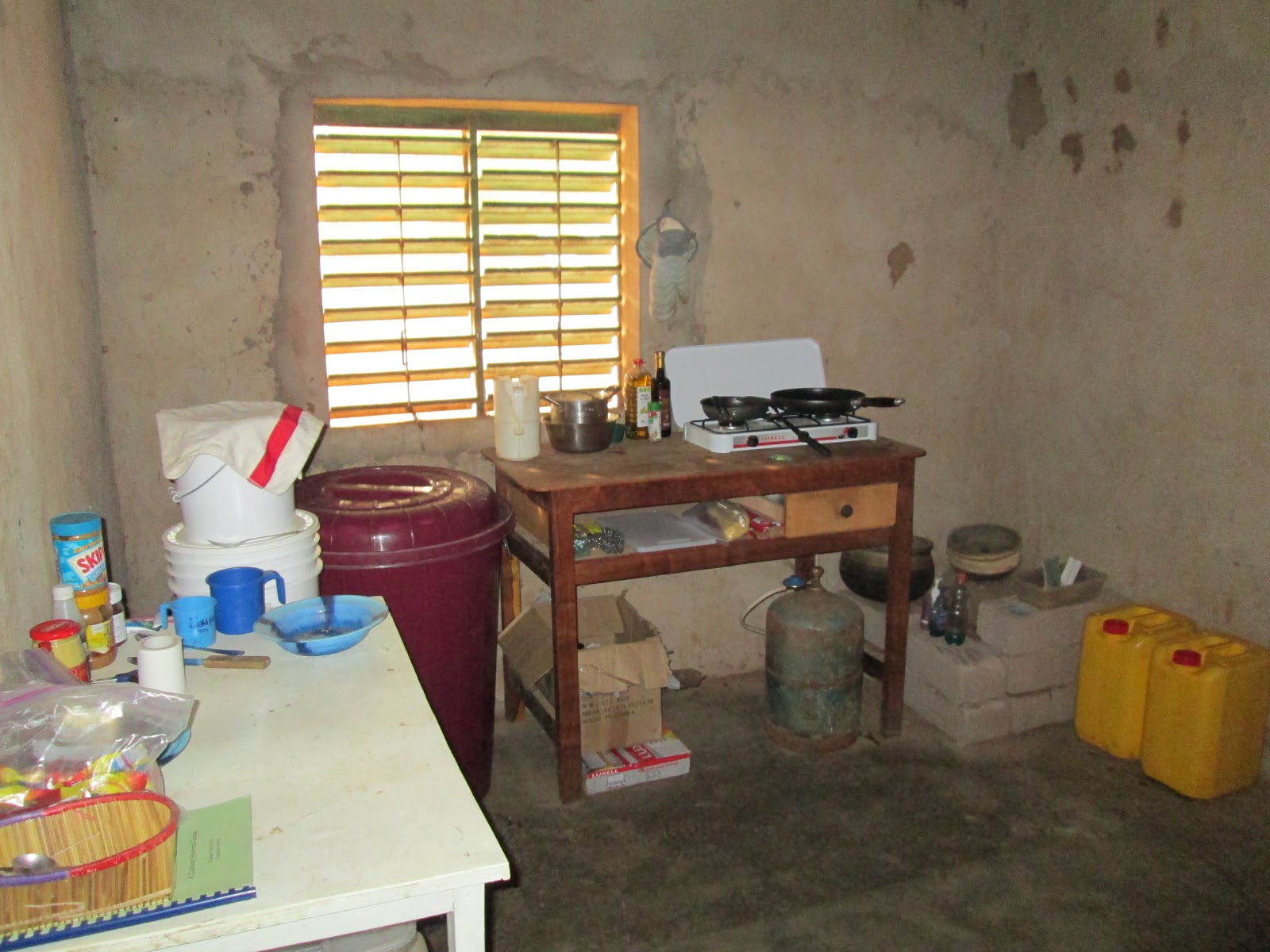
As far as my house is concerned, I feel like the winner of an unofficial site selection lottery that took place without the knowledge of Peace Corps Burkina Faso trainees.   After living in a one room, one window house for 2 months, I have moved to a ridiculous five room mansion: bigger than most of the apartments that my friends are now sharing with 4-6 people.  It’s definitely bigger than any property I will own until I have a decent job in the US (or elsewhere).  It’s a spacious five room / half bathroom house with a porch, a spacious living room, a kitchen, a bedroom, a workout room, and an office.  The kitchen appliances are brand new, the bed is a double, and the house is very well lit and ventilated.


Before you get too jealous, keep in mind that I still don’t have running water or electricity. My kitchen consists of a two higher tables for preparing food, a trash can for storing water, and a gas stove that’s connected to the gas tank below.  No electricity means no fridge, no blender, and, perhaps most importantly, no lights!  The sun sets around 6pm, which leaves me with the decision to cook dinner around 5pm or cook with my headlamp. My “office” consists of a book shelf, a dresser, and a small desk.  My “gym” is just an empty room with a mat on the ground.  The married volunteer couple before me left a double “mattress,” which in Burkina Faso is just a slab of foam on a rickety bamboo bed frame.


When considering the region of Burkina that I was placed in, it would not be a stretch to conclude that either my boss is rewarding me or she assumed that I would terminate my service if my single demand of “not the North” failed to be met.  To put it lightly, the southwest of Burkina Faso is FANTISTICALLY AWESOMELY WAY BETTER than the northern part of country (but don’t tell the volunteers in the north that, because they’ll claim bragging rights and talk about how hard their volunteer service is).  The climate is much more accommodating for a Californian, with temperatures dropping low enough for me to actually be cold at 6am (at least for now).  With higher levels of rainfall, the southwest is cash crop country: mostly sugar and cotton.  Powerful families in the villages profit greatly from the cash crop trade.  There is typically a wide diversity of agriculture in the southwest, with a variety of tropical fruits and vegetables available seasonally.  Most importantly, there are avocados available in my region.  I love avocados.


There’s a market every 5 days at a village that’s directly west of me.  It’s only 1.5 km as the crow flies, but the crow would fly over the ravine and the stream that divides the two villages.  There are a multitude of ways to get across, some easier than others, as I have found during my first week at site. But I’ll save that story for a future post.


In other news, here’s the blog of a fellow Peace Corps trainee (a USC Trojan) who ended her service after one night with a Burkinabe host family. Now pretending to still be in country........

http://www.lolitamunosespinoza.blogspot.com/

Filled with gross generalizations, pictures clearly taken from Google, and to top it off, an extremely condescending tone.
In conclusion, graduates of UCLA are of a higher moral caliber than graduates of USC.  Merry Christmas everyone!

Laundry, Burkina style