Thursday, March 27, 2014

The Obama Effect And Other Reasons Why People Want to Come to America

Let me begin with a disclaimer.  This post has absolutely nothing to do with US politics.  It does not debate healthcare reform, immigration policy, or the budget deficit.

But how can a phenomenon known as the Obama Effect have nothing to do with domestic US politics?  Come to Africa and see for yourself.  Electing Barack Obama as our president was arguably the best foreign policy move the US has made in Africa since PEPFAR.  Due to the simple fact that Barack Obama’s dad is Kenyan, people here identify him as “African.”  And hey, if a guy from Africa can become President of the United States, anything is possible.

It’s hard to describe how much people love Obama here.  They know nothing about him personally, nothing about his domestic political agenda, and nothing about his foreign policy initiatives.  Most Burkinabe cannot name a single other US president.  Yet images of Obama can be seen in every village and city of Burkina Faso. Kids and adults alike sport tank tops with his picture plastered on the front.  Images of Barack Obama appear on backpacks, flashlights, and lighters.  There are even toothbrushes that display his smiling face, as if to say “I’m Barack Obama and I approve this toothbrush.” 

While Burkinabe identify with Obama, they usually don’t pretend to know anything about him personally.  However, as Americans, they expect us to.  A common question in the Burkinabe greeting process is “How is your family?” which is occasionally followed by “And Obama?” as if we have any idea how the most powerful man in the world is doing.  I’m guessing  he’s probably pretty stressed out.

Burkinabe’s obsession with Obama illustrates a broader point.  Nearly everyone in Burkina Faso wants to come to America.  Our country is seen as “the promised land.” According to Burkinabe, everyone in America is rich , healthy, and happy.  If I told Burkinabe that the streets in America are paved with gold, they would believe it.  When I tell Burkinabe that there are homeless people in America, they don’t believe it.

Almost every day, I get asked to help someone get to America.  Most of the time, it’s phrased as a joke, but that’s like saying the marriage proposals that female volunteers get every day are “jokes.”  If you said yes, things would get serious real fast.  As the “take me to America” proposition is a daily occurrence in volunteer life, volunteers have developed different response mechanisms ranging from a repeated “no” to a more elaborate series of questions designed to ascertain how little the person in question has actually prepared to go America.

I usually begin by asking them if they speak English.  If they say no, I explain that no one in America speaks French or Jula or Toussian and ask them how they would communicate with people.  If they say yes, I ask them to speak to me in English.  Most Burkinabe who can “speak English” get as far as “Good morning. How are you?  I am very fine. Bye bye.”  More advanced speakers can add “Where are you going?” and “Give me money.”  Either way, I end up explaining to the person in question that they don’t know enough English and they should keep practicing.

Another entertaining line of questioning is to ask why the person in question wants to go to America.  This stumps most Burkinabe because they’ve never really thought about it critically.  For Burkinabe, the answer is so obvious that they…umm…..well…they don’t really know it.   In reality, a lot of Burkinabe would be terrified to be so far away from their family in a country that is a stark contrast linguistically and culturally to Burkina.

The “why” question seems ridiculous to Burkinabe due to the prevalence of “The Promised Land Assumption.”  This assumption is based on the fact that all of the Americans that they’ve seen on TV or heard about from their friend who has a friend who met one are rich and happy.  Therefore, it must be true that a person’s presence in America ensures immediate access to the riches of the Promised Land and guaranteed happiness.  For Burkinabe, the “American Dream” is simply gaining access to the country.  No thought is paid to the hard work and intelligence that it takes to be a successful immigrant in America.  “The Promised Land Assumption” provides the foundation for the classic Burkinabe “Take me to America even though I don’t speak English, have no family there, and no intention of working” argument.  Burkinabe think that just being American entitles you to certain things.

Are they right?  Well….in a sense…..yes.  As an American, you are entitled to a lot of rights and privileges that either don’t exist or aren’t enforced in Burkina.  But it’s ridiculous to assert that material wealth is so plentiful in the US that one is just entitled to it.  I mean that’s communism. And you know how us capitalist Americans feel about communists…

In short, Burkinabe have some serious misconceptions about America.  And I don’t blame them.  It’s a confusing place.  For example, the Burkinabe in charge of Safety and Security for Peace Corps Burkina Faso visited my site a couple weeks ago.  He saw the big California flag on my wall told me it was pretty.  Then he asked, “Why does it say California Republic?” He knew that the national government of US was a republic, but he didn’t know that each state has its own, separate representative government.  Clearly this man is well educated, has years of work experience with Americans, and has actually been to the US and other developed countries.  However, I could tell that my brief attempt to explain the concept of federalism didn’t make much sense to him.  To be honest, federalism in practice doesn’t make much sense to me sometimes either. 

Other aspects of America that Burkinabe find confusing (or just outright ignore):

-Size.  Burkinabe tend to conceptualize most countries of the world as similar in size to their own.  This includes the United States.  But the United States is a huge country.  Burkina Faso is only about the size of Colorado.  I like to tell Burkinabe you could fit 50 Burkinas inside the US. I’m aware that’s not very accurate, but it definitely helps them conceptualize the vastness of the US.

-Language.  The vast majority of Americans only speak English.  99.9% of Burkinabe do not speak English.  Yet they still think living in the states would be way easier than living in Burkina.  While many Burkinabe know 2, 3, or even 4 different languages, English is not usually one of them.  And if you can’t speak passable English, you’re going to have a rough time in America.

-Culture.  American culture is vastly different than Burkinabe culture in just about every way imaginable.  For example, “sexual harassment” is not a concept that exists in Burkina.  Women are called to, smooched at (a kissing noise directed towards a specific person) and hissed at (yes I’m serious).  To be fair, hissing is actually a common way of getting a waiter’s/waitress’ attention in Burkina, but it’s a horrifyingly demeaning practice from an American perspective. And that cultural understanding clearly doesn’t excuse the Burkinabe that direct it towards women in general.  In fact, the cultural understanding makes it even worse because hissing implies that the “hissee” (individual receiving hissing noise) is supposed to serve the hisser (individual making disgusting sound).   “Customer service” also doesn’t exist in Burkina.  Often times, the only way to get what you want in Africa is to be an asshole, a strategy that has been perfected by urban Burkinabe.   They’ve adopted an “ends justify the means” philosophy that includes an unwillingness to wait in lines. Instead Burkinabe will crowd the window/person that has what they need.  A typical Burkinabe male would get arrested within five minutes of stepping foot in an American restaurant.

-Climate.  It’s hot in Burkina Faso.  During the “winter” temperatures drop to the 60’s (in the middle of the night) and Burkinabe are freezing.  In fact, they don the heavy winter coats as soon as it hits 75.  It’s colder than 75 for most of the year in the states, even in desert.  In any city with a noticeable winter, Burkinabe would be miserably cold.

Due to all of the misconceptions above, it’s next to impossible to explain to Burkinabe how amazing my trip home was.  But my friends in village are satisfied to know that my parents and the rest of my family are doing well.  And that Obama is still president. In all seriousness, my trip back to the California was a whirlwind of awesomeness.  It seemed like I barely had enough time to see the people I wanted to see and do the things I wanted to do.  However, I managed to spend a significant amount of time with family, meet up with a ton of friends, and experience my favorite parts of home.  I won’t recap the whole trip, but some highlights included

-My nephew’s Bar Mitzvah.  It was amazing to be with my family as we came together to celebrate.  Congrats to my nephew!

-The beach and the ocean and surfing almost every morning.  Two of the best swells of the winter happened to hit the South Bay during the two weeks I was back.  I’ve touched on this subject in earlier posts (i.e. almost every blog post) but I LOVE THE OCEAN. Never again will I be away from it for so long.

-Las Vegas trip.  One of the dilemmas of my trip home was that I didn’t have enough time to visit my good friends in Norcal.  The solution?  Meet in Vegas.  We ended up with a random crew including my brother and his wife, good friends from high school, and good friends from UCLA.  It was hands down the best Vegas trip of my life.

-Food.  Amazing, glorious food.  I gained 15 pounds in two weeks.  I’ve since lost all 15.

-My bed.  It’s like a big comfy cloud.  I hadn’t been able to snuggle beneath a mountain of covers since my trip to Cape Town.  And it felt so good.

A lot of people asked if it was a “culture shock” to have spent so long in Burkina, a place that has so little, and then come to America.  There’s no doubt that I appreciated everything in a way that is difficult to describe (without sounding like a Peace Corps douche), but to say I was “shocked” would be an overstatement.  Everything was so easy back home.  I didn’t have any trouble adjusting and fell right back into things.   If anything, I was shocked to be so happy all of the time.  You don’t spend 22 years living one way and then completely forget how things were after 17 months in Africa.  In fact, you spend an unreasonable amount of time sweating in your hut and day dreaming about how awesome things were during those 22 years.

It’s safe to say that those two weeks I was home were the happiest weeks of the past 17 months of my life.  I was surrounded by the people I love most in the world.  I was constantly reminded how lucky I am to have people in my life who honestly care about me.  I know that’s a weird thing to say, but it’s easy to forget that feeling during Peace Corps service.  International texting and care packages are a poor substitute for actually smiles and hugs.  Much love to the friends and family who made my trip home awesome.  I’ll see all of you in 8 months!
Two of my favorite people in the world: my uncle and my grandma
Yeah..this is where I'm coming from


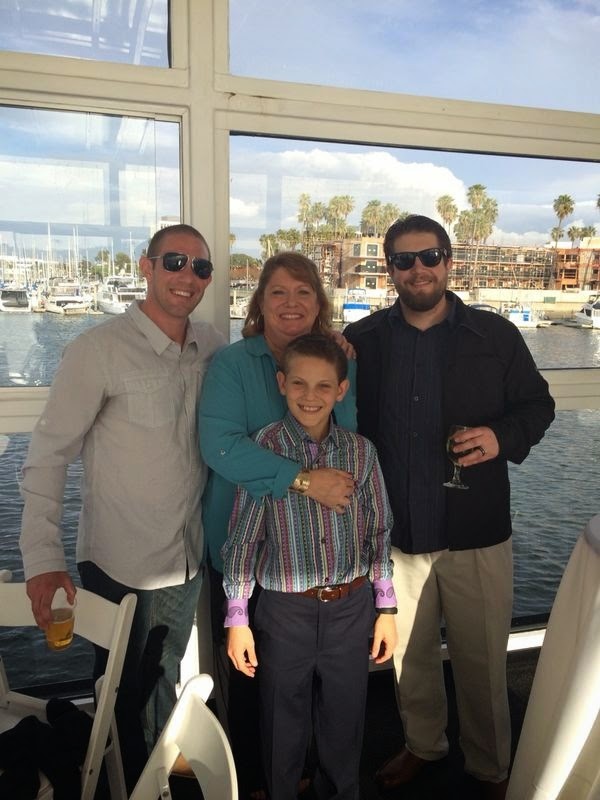
Mom, brother, and nephew...on a boat!

Sunday, February 9, 2014

Ça Va Aller

I’m changing the name of my blog.  I decided on the name “American Burkinabe” when I created it the month before I left for Africa.  I have since realized that it is misleading for a number of reasons.

The name “American Burkinabe” grew out of my perception that I might become culturally integrated enough during my Peace Corps experience that I would consider part of my identity to be Burkinabe, even after spending the first 22 years of my life in America. I was at a point in my life where I was frustrated with many aspects of American society and I was looking for a different way of life.  Making the commitment to living and working in Burkina Faso for over two years was obviously an extreme way to deal with this frustration, but I decided it was the best option available to me despite the mountains of job and grad school offers I was forced to turn down (0 and 0 respectively).

But throughout my service, I’ve found that, contrary to my belief that my Peace Corps experience would lead me to abandon part of my American identity, the opposite is true.  It has made more American.  I’m not going to start a self-righteous rant of how good we have it in the states, but we do.  I have never been so thankful to be born in a progressive and free society. I have never been more appreciative to have grown up in a huge, beautiful country that is easily accessible by reliable* forms of transportation.  The healthcare system of the US (despite the political battle over healthcare reform) is extremely good.   A vast majority of the population of the US has access to electricity, running water, and basic sanitation.  The education and work opportunities in the United States far surpass those available in Burkina.  Not to mention access to those education and work opportunities is much more widespread (although not as widespread as they should be).  All of these achievements were accomplished in less than 300 years.

*The word “reliable” is used in a relative sense. After Peace Corps, I would consider the ever present possibility of a 5 hour delay in an air conditioned airport surrounded by food and water “reliable” transport.   I would not consider the ever present possibility of a 5 hour bush taxi breakdown in sweltering heat far from food and water “reliable” transport.

I acknowledge that there are strong counterarguments to all of the points that I just raised, but the bottom line is that life is pretty damn good in the US. That being said, I hope I don’t come across as condescending.  I fully acknowledge that you don’t need to spend 2 years in one of the poorest countries of Africa to appreciate being American.  However, an experience like mine does give one a unique perspective on why being American is great.  To illustrate this point, I want to share a list I kept during my first few months at site to mentally cope with being away from the US for so long.   The contents of that list are as follows:

Things I’ll Probably Miss Most About Burkina
-Importance of family
-Unconditionally respect for elders
-$1.20 22oz beers
-Sunny beach weather almost every day
-Volunteer friends
-The sun seems bigger here (great sunsets, sunrises)
-Being my own boss.  All of the time.
-No worries about being prosecuted for downloading music illegally
-Excessive leisure time (reading, napping, listening to music)
-Fighting “the good fight” (not working for “the man” or the 1%)
-Living in a community where everyone knows each other
-Not having to be on time to anything or follow through on commitments

Things I Probably Won’t Miss About Burkina
-THE HEAT (THE SUN SEEMS BIGGER AND MORE POWERFUL HERE)
-Living in a community where everyone knows each other
-Lack of electricity
-Lack of running water
-Lack of basic sanitation
-Lack of fast internet / inability to download / inability to watch Youtube videos or stream anything online
-People not being on time to anything or following through on commitments
- NO OCEAN / BEACH / LARGE BODIES OF WATER
-Unmotivated coworkers and community members
-Lack of bacon
-Being stared at and called names every day
-Terrible Burkina pop music (Ivoire Mix DJ needs to be stopped)
-People trying to get stuff from me (money, US visa, etc.)
- Difficulty of travel
-Lack of ingredients to cook with / Lack of good restaurants
-Being out of touch with American culture / movies / TV shows / music / sports
-People always saying what they think I want them to say instead of the truth
-Sweating all of the time
-Being away from friends and family

You can probably see why I stopped making this list after a week or so.  As far as coping mechanisms go, it wasn’t the most effective.  Don’t get me wrong, I definitely appreciate certain aspects of Burkinabe culture, but to claim that I’ve adopted these cultural norms would be lying.  I understand them and I’ve learned how to deal with them on a daily basis.  Which I consider to be a pretty huge accomplishment considering American and Burkinabe culture almost always fall on opposite sides of the “culture spectrum.”

I would never frame my experience in Burkina Faso as negative.  It has not been a 3 month party filled study abroad trip to Barcelona, but it has been an extremely formative experience in my life.  I’ve never had so much time to figure out exactly what I enjoy and prefer.  I’ve never had so much time to dedicate to reading, listening to music, and watching movies.  I’ve become moderately fluent in French and developed excellent non-verbal communication skills.  I’ve learned more about sustainable development than any grad school program could ever teach me (although I’m still probably going to grad school).  I’ve made lifelong friends and strengthened my ties with friends and family back home (seriously I love you guys).

Which brings me to the new name of my blog, “Ça Va Aller.”  It literally means, “It’s going to go,” but also, “Life goes on,” when used in a philosophical sense and “You only live once” when used before making a particularly sketchy decision from which there is no alternative.  It’s a lingual manifestation of the fatalistic attitude that is prevalent in Burkina culture.  Which makes sense because it would be impossible to live here if you didn’t adopt this mentality at least 50% of the time you spend here, although I recommend 90% of the time for emotional sanity. 

In America, if something is goes wrong or something breaks, society’s response is, “Fix it,” or “Figure it out.”  In Burkina, society’s response is “ça va aller.”  From a work perspective, that attitude makes it extremely difficult to accomplish anything sustainable here, especially if there are unforeseen obstacles.  However, that attitude also makes it possible stay sane in a country where, more often than not, things don’t go as planned.

That attitude has allowed me to rework my definition of “success” and realize that just living in Burkina for 27 months is a huge accomplishment.  Getting a new debit card after getting my wallet stolen in July (a five month process) is a huge accomplishment. Being able to buy things at the local market in local language (however bad) is a huge accomplishment.  Completing a project (however small) with a Burkinabe counterpart is a huge accomplishment. Surviving in a culture where almost no one speaks passable English and even fewer people have ever been to the United States is a huge accomplishment.  


Do I still get frustrated here on a daily basis? Yes.  Do I feel like I’ve accomplished a lot here from a work perspective? No.  But do I regret coming to Burkina Faso to serve in the Peace Corps? Would I rather have spent that time in the states? Not for a second.  I am proud of my small successes here.  And the rest, well, ça va aller.

Saturday, January 11, 2014

Using Soccer to Teach....Finally!

After months of discussing my aspirations to use soccer to teach kids about health topics, I’m happy to report that I was finally able to accomplish this goal!  The trajectory of my service that led to this 4 day project goes something like this:

In May 2013, I took Ibrahim and another village counterpart to a training for volunteers and their counterparts run by an organization called Coaching for Hope.  The organization focuses on using soccer to teach young people about HIV/AIDS. The seven day training was a great experience for the Americans and Burkinabe that attended.  Burkinabe loved the facilitation techniques used by the coaches and often seemed to forget that they were being trained to teach others, not to play soccer.  At the end of the training, my counterparts were each given a soccer ball and a certificate for completing the training. 

Upon returning to village, however, I realized that implemented the Coaching for Hope program would be difficult.  As there is only a primary school in my village, middle school and high school students bike 5 km to the adjacent village to continue their schooling.  Unfortunately, the adjacent village isn’t in the coverage area of my health clinic, meaning I’m not supposed to be doing projects there.  And obviously primary school is a little too young to discuss sexual health, even if soccer is involved.

I was still determined to implement the program, so I convinced Ibrahim to come play soccer with a group of young men I’d been playing with on and off.  The guys were happy to get a couple new soccer balls, but they were confused when, after a week, Ibrahim and I sat them down and tried to explain the Coaching for Hope program.  These guys were already in school for 8 hours a day.  They just wanted to have some fun and play soccer until it got too dark to see.  So Ibrahim and I let them use the soccer balls we had gotten from Coaching for Hope until they were both broken.  To be fair, the guys took good care of the balls.  They lasted for 3 months, which is a long time by Burkina standards.  A group of Burkina children can destroy a soccer ball in a matter of days.

During the months June and July I continued to play soccer when I could, but Ibrahim lost interest and was spending most days working on a project based in Banfora.  However, during a June meeting of the HIV/AIDS Committee there was a ray of hope.  An NGO called Grassroots Soccer (GRS) had contacted Peace Corps Burkina and offered an array of partnership options for Peace Corps volunteers.  GRS is similar to Coaching for Hope, but they are a larger NGO, more focused on health education than soccer, and have a department specifically dedicated to forming partnerships with Peace Corps countries led by a former Zambia Peace Corps volunteer named Kristen.  I immediately volunteered to take the lead on communicating with GRS.

I discussed my aspirations with another volunteer on the committee, Alex, and we researched GRS partnerships opportunities.  We contacted Kristen and requested individual GRS kits, which the organization will send to Peace Corps volunteers free of charge.  During the research, we also found that GRS had an office in Cape Town, where I happened to be traveling to in mid-August.  I contacted Kristen and found that she worked in the Cape Town office.  We agreed to meet during my August vacation.

The meeting with Kristen was phenomenal.  We discussed the programs that GRS had developed specifically for PCVs and how GRS was involved in other Peace Corps countries.  It became obvious during our discussion that many other Peace Corps country offices have WAY more money to spend on trainings and projects than Burkina.  One of the reasons is the US Government’s PEPFAR initiative (President’s Emergency Plan for AIDS Relief), which allocates billions of dollars of aid money to fight HIV/AIDS in sub-Saharan Africa.  Peace Corps offices in many of the countries in southern Africa with high HIV/AIDS prevalence rates receive large chunks of PEPFAR funds. Burkina receives no PEPFAR funds due to the low HIV/AIDS prevalence rate in the country.

However, Kristen mentioned that GRS had leftover funds in the expansion portion of their budget and that she’d be open to working with PCBF to set up a training in January for volunteers and their counterparts.  Clearly this was an incredible opportunity, as GRS was offering to send a training team and materials.  I quickly emailed our acting country director to discuss adding the training to the end of the In Service Training of the new education group in January.  He promptly turned it down, claiming the budget had already been set for the 2014 fiscal year and that adding days to the IST would cost PCBF between $5,000 - $10,000 extra.  While his first point was true, his second assertion was completely false, as most hotels in Burkina run about $15-$20 per night and transport was already covered by the IST budget.  However, I was in no position to argue and informed Kristen of his decision before leaving Cape Town.  While neither of us were completely surprised after our respective Peace Corps experiences, we were still disappointed.  We agreed that GRS expansion in Burkina was going to have to be mainly volunteer-led.

In October, however, our Director of Programming and Training, Paul, met with Kristen during a Peace Corps training conference in South Africa and became interested in GRS.  He encouraged me to work with GRS to set up a training for the new group of education volunteers that had been sent to site at the end of August.  Clearly this was frustrating to hear after Kristen had offered exactly the same thing during our Cape Town meeting.  But he agreed to continue to work with me to set up a GRS training in the coming year.  Unfortunately, Paul resigned for family reasons the week after Thanksgiving.

After further discussions with Kristen, I realized that Paul had neglected to inform me that Peace Corps country offices pay GRS around $10,000 to conduct a training, not including the transport and lodging costs of participating volunteers and counterparts.  Kristen also informed me that GRS only allows certified trainers to conduct GRS trainings, which means that I wouldn’t be permitted to set up a GRS training of my own, regardless of any experience I gained implementing the programs.  Considering the budget for the entire fiscal year of 2014 for HIV/AIDS projects in Burkina is around $15,000, Peace Corps Burkina would never be able to afford an official GRS training.

During October, I was busy assisting with the training of the new group of volunteers, but we finally received our packages from GRS at the end of the month.  It was pretty discouraging to find that the kits took over 3 months to get from South Africa to Burkina, but not altogether surprising.  The kits contained the Peace Corps SKILLZ HIV/AIDS education program in both English and French, the Peace Corps SKILLZ Malaria program in English, monitoring/evaluation tools, a flash drive with electronic copies, and an “indestructible” soccer ball.

During November, I explained the GRS program to Ibrahim and consistently tried to work with him to translate the SKILLZ Malaria program to French.  This process was extremely frustrating for many reasons, but mostly because my written French is terrible and Ibrahim was super flakey with meetings due to continuing work with the project in Banfora.  He had told me his contract with the organization was done in November, but apparently they had asked him to stay on in some capacity or he was trying to make himself valuable enough for them to keep him on.  Either way, it became clear that this project was only happening because I wanted to do it, which is contrary to the development approach of the Peace Corps but seemed to be the only way to accomplish my goal. 

My plan was to finish writing out the French translation at site, then type it up and print it out during a Thanksgiving trip to Ouaga.  I can’t exactly use my computer for long periods of time at site due to lack of electricity.  During translation, I also realized that the SKILLZ Malaria program could be organized better and needed to be adapted to the Burkina context, which involved updating the English manual as well.  Combined with the fact that I wasn’t getting much help with the translation, I didn’t accomplish as much as I thought I would at site.

When I arrived in Ouaga, I dedicated an entire day to working on the English and French versions of the SKILLZ Malaria program.  I realized that it was the first time I had sat down to do actually work at a computer in over a year.  Gone was my college era ability to sit down at a computer and crank out a 10 page research power in 8 hours.  So I trudged through a day of work, accomplishing less than half of what I planned to.  I took an extra day in the capital and still didn’t finish, but that may have been due to an intense food hangover the day after Thanksgiving.  I was getting burnt out so I decided to finish and edit the program at site, then print out the finished version in a regional capital.   

One of the key obstacles to any project in Burkina is the issue of money.  PCVs have to convince any counterparts they work with to volunteer their time. If you need money to buy materials for a project, you can apply for a grant from the Peace Corps office, you can find a person (or people) in the  community who will donate to the project, or you can pay out of your own pocket (clearly not recommended).  Luckily, I didn’t have to deal with any of these options, as there were leftover soccer balls and mosquito nets from a Science Camp that I had helped out at during September.  The volunteer who organized the camp was kind enough to leave the leftover supplies in Bobo, which I picked up on my way back to site.

When I returned to site after Thanksgiving, it took me about a week to get Ibrahim to set up a meeting with the director of the primary school.  We met and the director agreed to dedicate 3 afternoons to the SKILLZ program, which Ibrahim and I agreed was enough time to fit in the 4 practices of the program.  Unfortunately, I was going to traveling to Ouaga again for the Swear In ceremony of the new volunteers and wouldn’t be returning from the capital until a day before the project, which left little time for preparation. I gave him the completed manual before I left and asked him to read it and be prepared when I returned.

I met with Ibrahim the day after I got back from Ouaga and we briefly discussed the program for the first day of SKILLZ Malaria. While he claimed to have read the manual, it was pretty clear that he hadn’t.  Luckily he’s about as good at improvisation as Burkinabe can get. We showed up to the school to start the program and of course no one was there.  The kids usually get a half day on Thursdays, so even though the director had told them to come back at 3pm, there were no guarantees.  By 4pm, though, around 30 kids had showed up and we were able to start.

The first practice focused on the basics of malaria, making sure kids understood that it’s a serious disease that can kill you, which people often don’t acknowledge in village.  We used the game “Bed Net Ball,” to illustrate the basics of malaria prevention.  Three teams used bed sheets to throw a ball as high as they could in the air and then catch it.  The concept of “teamwork” is not well understood by Burkinabe children, so Ibrahim and I quickly realized that we had to demonstrate how to work together to throw the ball up in the air and catch it.

After the kids could successfully throw the ball up in the air and catch it, we told them that the bed sheet represented a mosquito net and the ball represented a mosquito with malaria. The goal of the game was to throw the ball as high as they could into the air and then cover themselves with the “mosquito net” before the ball hit the ground.  Anyone who wasn’t covered when the ball hit the ground got “malaria” and had to go see the major at the health clinic (a coach standing between the groups) to get prescribed medicine (a high five).  The game was a huge hit.  Burkinabe children don’t get to play organized games very often (if it all), which makes teaching them one incredibly difficult, but makes even the most childish games extremely popular with youth of any age.

Bed Net Ball!

Friday afternoon we ran into a variety of different problems.  All of the kids were at school in the afternoon, but we were only doing the SKILLZ program with the oldest class of 30-40 kids.  Luckily we had made an attendance sheet the day before and called role to make sure we got the same group of kids. Apparently, the teachers were neglecting to teach the other classes that afternoon.  This made the next hour an exercise in herding away the Burkinabe kids who weren’t participating, which can only honestly be accomplished by threatening to hit them.  While I wasn’t comfortable doing this, Ibrahim was.  I guess that’s what counterparts are for!

The second practice was focused on proper mosquito net usage.  After a brief warm up, four teams competed to set up a mosquito net properly using string tied to whatever tree branches or other forms of support the kids could find.  After the groups were finished, we walked around with everyone and critiqued the setup, asking the kids to fix any problems.  Clearly the main goal of the competition was to reinforce proper bed net usage, but the exercise was also designed to demonstrate that mosquito nets can be set up anywhere, both inside and outside.  Many Burkinabe sleep outside during the hot season without mosquito nets, leading to hundreds of unnecessary cases of malaria.

How many kids can fit under a mosquito net?
The last two practices were to be conducted on Saturday afternoon, which Ibrahim and I both had reservations about.  Kids only have school for half the day before they are released for their weekend.  But Sunday was an even worse option, as most Burkinabe dedicate the day to family and expect kids to be at home.  Saturday afternoon we prepared and went to the school, but only about 20 out of the 35 kids who had participated in the program showed up.  I wanted to reschedule the sessions for Monday, but the school director wasn’t home and he wasn’t picking up his phone.  We told the kids that we there weren’t enough people to complete the program that afternoon and they were legitimately disappointed.  They asked how many kids they needed and promised to get at least 30 people from their class to the school tomorrow morning.  I was pretty blown away because Burkinabe kids rarely plan ahead to make time for health education, but clearly that was one of the benefits of designing health education around soccer.  We decided to trust the kids and told them we would come to the school at 9am the next day.

The third practice focused on proper treatment of malaria, emphasizing the risks of using traditional medicine and/or street medicine.  Many Burkinabe will buy malaria medicine from traveling salesmen who assure them that it is better quality than the medicine from the health clinic.  Burkinabe also still hold traditional healers in high esteem, depending on the community.  After reviewing the symptoms of malaria and the risks of taking street and traditional medicine, we divided the kids into six teams and played “Health Ball.” The goal of the game was to pass the ball as many times as possible between the members of the team without letting it touch the ground.  The twist was that half the teams were given a regular soccer ball and the other half a tiny plastic ball.  We switched the balls between teams then brought the group together to watch two teams compete.  We told them that both teams had been infected with malaria. The team with the soccer ball had gone to the CSPS to get prescribed medicine, while the team with the small ball had taken street medicine.  The first team to make 5 successful passes “got healthy.”  The kids tended to care way more about the unfairness of the competition than the overarching health message, but I think we got the point across.

Easier to pass with a soccer ball = Easier to cure malaria with the proper medication
The last practice was designed to encourage the kids to confront malaria risks in the community and educate others.  We used the concept of a red card in soccer to illustrate how to confront risky behaviors.  We had come up with short theater sketches that illustrated common scenarios of prevention, adherence, and treatment.  All of the kids were given a red card and told to silently “give it” when they viewed a risky behavior in each sketch.  Each sketch was followed by a discussion of why the red card was given and whether or not it was a common scenario in village.  Ibrahim and I demonstrated the first sketch then called on volunteers to play the roles in a few more.  They pretended to take traditional medicine, cut mosquito nets, and refuse to go to the health clinic while their peers gave them red cards for each risky behavior.  They loved it.

Giving the Red Card

Red Card Skit


Evaluation of the SKILLZ program was conducted through a small activity at the beginning of each practice called “Take a Stand.”  We would ask the students to close their eyes, then read potentially controversial statements about malaria and ask the students to put their hands on their heads it they agreed.  After we noted the results, we had the students open their eyes and called on volunteers to defend their position.  It was difficult to make sure the children were being honest and not just following the group, but there were still a few kids who would argue the wrong side of each statement. The last practice was then followed by a post test consisting of the “Take a Stand” statements of each practice.

After the last practice, Ibrahim and I sat down to eat some chicken at a new bar in town that is conveniently located right next to the primary school.  We chose a live chicken and the waitress took care of the rest, delivering an amazing grilled chicken 45 min later.  I’m not sure if it was the occasion, the papaya we cut up as an appetizer, or the actual chicken, but it was one of the best I’ve had in Burkina.

Overall, I’m extremely happy that I was finally able to complete this project.  I was able to observe a clear improvement in the students’ comprehension of malaria prevention and treatment through the soccer program. I’m planning to discuss the SKILLZ Malaria program with the Community Health Agents in the two other villages within my health clinic’s coverage area to see if we can implement it at those primary schools as well.  I’m also working with the HIV/AIDS committee to get the GRS HIV/AIDS materials to a small group of volunteers in the new education stage to implement at their site.  Hopefully these experiences will provide a catalyst for the expansion of Grassroots Soccer programs in Burkina Faso.

Peace Corps is notoriously bad at providing volunteers with actual materials and programs to implement at their site.  Grassroots Soccer is an organization that recognizes this shortcoming and is actively working to address it.   Not to mention their methods of monitoring and evaluating the SKILLZ programs are miles ahead of anything taught by Peace Corps.  I specifically remember a moment in the Cape Town office when Kristen showed me a graphic breakdown of GRS involvement in individual Peace Corps countries.  It blew me away after dealing with the MS-DOS retro results reporting program of Peace Corps.  The level of competence and adaptability of Kristen and other members of the Grassroots Soccer staff has been extremely refreshing after dealing with the stifling bureaucracy of Burkinabe organizations and the Peace Corps Office here.


But nothing that’s easy is ever worth doing right?  Except making a quesadilla in the microwave.  Or lying on the beach. Damn that’s not a good maxim at all.

It's hard to get people to sleep under these things.  This one was just being used in a friendly game of tug of war between village dogs

Thursday, January 2, 2014

Do They Know It's Christmas?

Happy Holidays everyone! 

I was able to spend Christmas at Hallie's site and NYE in Ouaga, so I've had a great holiday season!

Bush Taxi to Padema, Hallie's site.  Classic America shout out on the windshield. 


Our Christmas tree and stockings


While hanging at Hallie's site listening to Christmas music, we came across the classic single, "Do They Know It's Christmas?"  It suddenly hit us that the lyrics to this song were  hilarious offensive, implying that Africans had no idea what Christmas was and spent the holidays suffering in ignorance.

Granted the song was released to raise money for a 1985 famine in Ethiopia.  And then re released 2 more times by The Band Aids, selling millions of  copies.  In any case, it's a good example of the many assumptions that are made about life in Africa, often by people who've never been here.  

To answer the central question of the song, YES THEY DO KNOW IT'S CHRISTMASTIME IN AFRICA EVEN IF THERE'S NOT F***ING SNOW.  They celebrate with family and go to church and get drunk, like many of us do in America.

Without further ado, here are the lyrics to that beautiful holiday song...

It's Christmastime; there's no need to be afraid
At Christmastime, we let in light and we banish shade
And in our world of plenty we can spread a smile of joy
Throw your arms around the world at Christmastime
But say a prayer to pray for the other ones
At Christmastime

It's hard, but when you're having fun
There's a world outside your window
And it's a world of dread and fear
Where the only water flowing is the bitter sting of tears

And the Christmas bells that ring there
Are the clanging chimes of doom
Well tonight thank God it's them instead of you
And there won't be snow in Africa this Christmastime

The greatest gift they'll get this year is life
Oh, where nothing ever grows, no rain or rivers flow
Do they know it's Christmastime at all?

Here's to you, raise a glass for ev'ryone
Here's to them, underneath that burning sun
Do they know it's Christmastime at all?

Feed the world
Feed the world

Feed the world
Let them know it's Christmastime again
Feed the world
Let them know it's Christmastime again

Wednesday, November 27, 2013

The Mystery of the Sign…and other projects I had nothing to do with

As any (honest) Peace Corps Volunteer will admit, a significant amount of things happen in your village without you knowing about them in advance, especially if you’ve been gone for any period of time. But even when you are at site, sometimes things just happen without you.  From a development perspective, this is encouraging.  If Burkinabe in your community are taking the initiative to address their needs and set up things without you, they are proving that they are capable of utilizing resources already available in the community to accomplish their goals.  If the national government has intervened in your community, it shows that (at least to some extent) the Burkinabe in charge of things are actually working to address the numerous economic and health issues faced by the largely rural, poor population of the country.

On the other hand, foreign entities can also have an impact on your community.  These NGOs often intervene in communities without first consulting the local population.  An NGO might intervene to address an issue that they view as a hindrance to development, but if the community does not share that view, the project will not achieve any real change.  An NGO might fund a series of health education events, providing resources that wouldn’t otherwise be available in the community.  They accomplish their goal of x number of education events or spend all of the funds allocated to the project.  Then they leave.  While x number of community members were “educated,” this approach is completely unsustainable. When the funding runs out and the NGO leaves, no one continues their work.  An NGO might fund the construction of a water pump in a community to improve water access. But when the pump breaks (as everything in Burkina does), community members won’t be able to or won’t consider it their responsibility to repair it.

As Peace Corps Volunteers, our role is supposed to be different, as we are charged with the task of improving our community’s capacity to address their own needs.  If our communities demonstrate this ability, it should be considered success.  In theory, our projects are supposed to empower host country nationals and give them ownership of the project, ensuring sustainability. However, this is an extremely difficult goal to accomplish. So when things happen without us, our suspicions are aroused.  In the past month, there have been a number of these types of suspicious happenings in my community.

Ibrahim’s Theater Presentations

The day after I returned to site in October, I caught up with my community counterpart, Ibrahim.  He informed me that the next day he had organized a theater performance in the village and would like for me to come.

Some background:

Since I arrived at site last December, Ibrahim has been working on a project based out of Banfora (15km away) organized by OXFAM Canada and an NGO called the One Drop Foundation.  The goal of the project is to improve sanitation and hygeine in the region through theater performances, latrine building, and waste management.

Throughout the months of January, February, and March, October, and November Ibrahim was a member of the project’s theater troupe, which traveled to many of the villages in the region.  They traveled with a stage, sound system, lights, and a generator provided by the project.  The performance was the same every time, with a plot concerning a village that had polluted their water supply and had to deal with the consequences.  The performance was extremely impressive and drew relatively large crowds for each performance.   

In January, Ibrahim organized a community trash pickup and a theater performance for the primary school kids in Takaledougou.  For at least two weeks of each of the months April-September Ibrahim attended trainings in Banfora (regional capital 15km away) on various topics related to theater and performance, paid for by the project.  In August, four latrines were installed in the main area of my village.  In September, four trash cans with the Oxfam logo were also installed.

Back to the present:

As far as I knew, Ibrahim hadn’t organized a theater performance in village since the larger performances ended in March.  This particular theater performance was held in the central area of Takaledougou during the day.  The whole play was basically an argument between two couples about where the proper place to shit is (a lot of yelling in Jula).  After the performance, Ibrahim called up individuals from the audience to put on the clothes of certain characters and ask them what they what they would have done instead.  It was a great way to encourage the audience to analyze what they had seen and evaluate whether they had learned anything. However, as with most of the Burkinabe theater performances I’ve seen, people immediately started leaving once they realized the performance was over and they were going to be asked questions.
Ibrahim working the crowd

Clearly it was a really impressive event to set up in village, so after the performance I congratulated Ibrahim. We talked for a while and he explained that he wanted to invite me to another theater performance in a satellite village, but it had been canceled. When I asked why, he said that the project didn’t have the funds available yet so they were postponing the performance.   He then dropped the bomb that each theater performance costs this organization 60,000 CFA ($120) when you add transport, a sound system, oil for 4 hours of the generator (most performances are done in villages without  electricity), and payment for actors/employees.   To put this in perspective, entire Burkinabe families live on less than 1,000 CFA ($2) per day.   I get paid about 140,000 CFA ($280) per month, which most Burkinabe would consider a massive amount of money (cue laughter from my gainfully employed friends).
Proof that Burkinabe love theater performances

Obviously this project has done some great things for the people in my community. It has given Ibrahim countless hours of theater training, built four latrines near the main part of my village, as well as encouraged Ibrahim to set up trash pickups and theater sensibilizations.  Not to mention the project has temporarily employed a few members of my community and paid them handsomely for their work.  However, this NGO has also complicated my work in village.  First of all, my main village counterpart is almost always busy working for this organization, making it difficult to work with him on other projects. This is especially frustrating because he is an amazing counterpart and I haven’t found any other community members that actually have the time or desire to work with me on health education projects.

The organization has also temporarily provided Ibrahim and the rest of the theater troupe with resources they would not otherwise have easy access too, such as a stage, a sound system, and a generator.  Now Ibrahim is of the opinion that he needs a sound system for every theater performance that he does in the future, which is simply not true. This has made it extremely difficult to work with him on any theater related projects because the resources Ibrahim thinks he needs don’t exist in the community.

The Mystery of the Sign

Three days after returning to site in October, I woke up to find that this giant sign had been installed next to the highway that passes by my village.


This translates to “Development Project of Agriculture Financed by the American People.”  The sign carries the logo of the Millennium Challenge Corporation, an initiative of the American government that assists developing countries in reaching the “Millennium Challenge” goals of the United Nations.

The chief of the village happened to drinking coffee at the same place as me, so I decided to ask him where the sign had come from.  He explained that some people had showed up the day before with the sign and the manpower/tools to install it.  They had tried to put the sign next to the highway in one location, but he had told them it wasn’t possible because it blocked a pathway next to road.  So they ended up installing the sign a little bit further down the highway.  The chief of the village had no idea what “Development Project” the sign was referring to and suggested that it was probably something in Banfora (15 km away).  After some research it has become apparent that no one in my community knows what the sign refers to.  It was probably installed there because cars have to slow down for the toll booth next to my village.

Cinomade

Four days after returning to site, a Burkinabe organization called Cinomade came to my community.  I’d never heard of the organization before, but it was actually really impressive.  They set up screenings of HIV/AIDS educational videos that were filmed and edited by Burkinabe in the southwest region of Burkina.   They spent the day before the screening walking around my community interviewing people about HIV/AIDS. For the screening, they set up a large projection screen at the primary school complete with a sound system and a generator.

They played back some of the footage of the interviews during the day and the Burkinabe loved it.  Then they showed the first of 3 of the videos they had made called “War of the Sexes.” The entire film was composed of interviews with over 40 individuals asking their opinions on what members of the opposite sex look for in a sexual partner and who is to blame for the spread of STDs.   Married women generally agreed that they can’t control the actions of their husbands and that unfaithful men were to blame.  Young women said they look for men who have the means to support a family, but pointed out that a husband with money can do whatever he wants after marriage.  Young men said that women won’t pay attention to them if they don’t have money and that promiscuous women in search of money were responsible for the spread of STDs.  Older men said they actively sought out younger sexual partners to reduce the risk of getting STDs.

After the film, the facilitator asked audience members to get up and offer their opinions on the questions posed in the film.  This resulted in a lot of young men standing up  and speaking into the microphone.  I was extremely impressed that a woman had gotten up in front of everyone to argue with the men, but I realized that this woman was from Cinomade.  After nearly 45 minutes of heated argument concerning who’s to blame for the spread of STDs, I grew pretty skeptical of the value of the discussion. Finally the director of the primary school got up and made an important point.

It doesn’t matter whose fault it is that STDs spread, it is the responsibility of both sexes to be educated and take measures to protect themselves.   A couple minutes later, the generator ran out of gas the event came to a grinding halt.

I left the event with mixed feelings.  The organization was successful at getting people to talk about sex and HIV/AIDS, which are very sensitive issues in Burkina Faso, but their focus on the “War of the Sexes” seemed counterproductive. It’s valuable to acknowledge different perceptions of sex between genders, but it’s hard to imagine that anyone walked away from the event understanding the importance of what the primary school director said.  The event was also poorly planned, with the generator shutting off in the middle of a speech by the head nurse of the CSPS.  In typical Burkina fashion they started the substantive part of the event 1.5 hours late.  Therefore, they weren’t able to show or discuss the other two films the organization had made, which may have tied together the loose ends left by the “War of the Sexes” video.

Interestingly enough, parents in my community didn’t care if their kids were present for these conversations regarding sex and HIV/AIDS, including a condom demonstration.  Whether they actually wanted their kids exposed to it, they figured their kids wouldn’t understand most of it, or they acknowledged their inability to keep hordes of kids away from a giant movie screen is a mystery to me.

Conclusion

While I’m happy that these projects (with the exception of that sign) are benefitting the people of my community without my involvement, each project is frustrating in its own way. 

Ibrahim is an incredible Burkinabe, but I haven’t been able to work with him on projects for months now because he doesn’t have time and I can’t provide the resources that the project in Banfora provides, namely sound equipment and a stipend. 

The project funded by Oxfam Canada and the One Drop Foundation is the perfect example of a project that doesn’t assess community needs before intervening.  The organization is focused on the public health issues of sanitation, hygiene, and waste management.  No doubt these are problems everywhere in the developing world, but if the community doesn’t view these as public health issues, they will not change their behaviors.

No one in the community thinks the plastic bags strewn about on the ground are a problem. They are going to continue littering even when trash cans are installed and a theater performance tells them not to.  The main message of the regional theater troupe’s performance was to avoid contaminating the water supply.  Not once was hand washing, the core component of hygiene health education, mentioned in any of the theater performances.  The four latrines that have been built in the community are clustered together in a central “marche” area that isn’t residential.  It is highly unlikely that someone not using a latrine before would hike to the central area of town before taking a crap.

And that sign.  I could go on for days about that sign, but let’s just say it’s hard to be seen as a legitimate representative of the American people when I can’t even explain what that giant sign is referring to.

Alas, my vacation to Ghana was canceled at the last minute due to injuries my good friend sustained during his travels, but all is well. I’ll be spending Thanksgiving in Ouaga with my entire training group (G27).  We’ll be eating turkey and drinking awesome home brewed beer! 

Let me explain. At an “Oktoberfest” event last month I met an embassy employee, Chris, who brews his own beer.  I sampled his Imperial IPA at the event and immediately fell in love.   I’ve considered brewing in Burkina, but concluded that it was impossible largely due to the fact that most beers need to ferment for 1-2 weeks in the low 70’s.  In Burkina, the temperature fluctuates between 90-120.  When I asked him about this, he admitted that he has a room in his house dedicated to fermenting beer and he keeps the air conditioning on full blast 24/7.  I cringed a little at this revelation, but decided to forgive him because he brews great beer and he’s super nice.  The guy offered to brew us beer whenever we wanted as long as we gave him advance notice.  For Thanksgiving, he’s brewing us a vanilla coffee porter and some girly fruity beer (that I’m going to publically proclaim is way better than the porter).  Unfortunately, he’s already married.

I also met the new US Ambassador at this “Oktoberfest” event, mistook him for a  Burkinabe, told him his English was really good and asked him what his job was.  Apparently my friend Amber was giving me all sorts of non-verbal cues that we were talking to the Ambassador.  I never learned to speak non-verbal female, which I had considered advantageous until that moment.  The new ambassador actually worked for Peace Corps in several African countries.  He’s the first African to immigrate to the US, become naturalized, and return to Africa as a US ambassador.  Needless to say, Peace Corps Burkina is enjoying a lot more attention from the embassy now.  The “Swear-in” ceremony of the new stage will even take place at the US Embassy in Ouaga!

At "Ouagktoberfest" with the US Ambassador to Burkina
To recap, these projects are frustrating, but at least things are happening.  Except for that sign.  Ibrahim is done with the Banfora project for now, theoretically freeing him up to help me with the Grassroots Soccer programs I want to get off the ground.  We’re working on translating the English manuals to French.  I met the only person in Burkina who brews good beer and fell in love.  The US Ambassador probably thinks I’m

a)    an idiot
b)    a drunk  
c)    a clown
d)    all of the above


And lastly….Happy Thanksgiving!  It’s times like these that I miss my family and friends the most, but I’m surrounding myself with friends, beer, and food which will hopefully dull the pain.  I can’t even begin to describe how thankful I am to have grown up with where I did and with the people I did.  Sending love from  Burkina……might take a couple months to get stateside.